Category Archive : best marriage counselor in Delhi

marriage counselor Shivani Sadhoo talks about cultivating positivity in challenging relationshships

Hand in Hand Through Tough Times

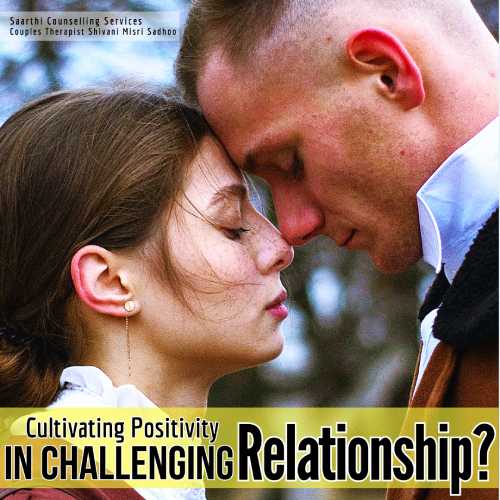
Cultivating Positivity in Challenging Relationships Explains Couples Therapist Shivani Misri Sadhoo

Relationships, whether romantic, familial, or platonic, are not immune to the trials and tribulations of life. Stress, disappointment, personal struggles – these are all ingredients in the complex recipe of human connection.

Yet, it’s how we weather these storms together that defines the strength of our relationships. When negativity threatens to cloud our judgment and dampen our spirits, it’s essential to remember that positivity is not just a fleeting emotion but a skill that can be cultivated and honed over time. Much like a muscle, it requires consistent effort and practice to develop resilience in the face of adversity.

marriage counselor Shivani Sadhoo talks about cultivating positivity in challenging relationshships

How do we cultivate positivity amid challenging relationships?

Let’s hear what a leading marriage counsellor in Delhi, Shivani Misri Sadhoo, has to say about this.

1. Think Positive

When faced with difficulties in relationships, it’s natural to dwell on the negative aspects and become consumed by frustration or disappointment. However, choosing to redirect your thoughts towards positivity can be transformative. It’s not about ignoring the challenges or pretending they don’t exist; instead, it’s about adopting a mindset that seeks solutions rather than dwelling on problems.

Positive thinking involves reframing your perspective. Instead of viewing obstacles as insurmountable barriers, consider them as opportunities for growth and learning. This shift in mindset can be a game-changer in relationships, as it opens the door to constructive communication and collaborative problem-solving.

2. Honest Communication

Effective communication is the cornerstone of any healthy relationship. In the face of challenges, it becomes the bridge that connects individuals, facilitating a deeper understanding of each other’s perspectives, needs, and emotions.

Honesty, the raw material of this bridge, is the foundation upon which trust is built. When individuals can openly express their thoughts and feelings, they create an environment conducive to growth and resolution. Honest communication acts as a powerful antidote, dispelling the toxicity that can accumulate in the absence of dialogue.

3. Differences Aren’t Always Bad

One of the greatest obstacles we encounter in relationships is the expectation that others should think and behave like us. This expectation creates a barrier to genuine connection because it overlooks the beauty of diversity.

When we approach relationships with a mindset of uniformity, we miss out on the opportunity to learn from contrasting perspectives and experiences. We limit the scope of our understanding and growth. Embracing differences is not merely a virtue but a necessity in cultivating positivity in challenging relationships.

4. The Power Of Time

In the hustle and bustle of our modern lives, where time seems to slip through our fingers, cultivating positivity in relationships can be a challenging yet profoundly rewarding endeavor. Amidst the complexities of personal and professional connections, one powerful and often underestimated tool for nurturing positivity is the simple act of giving people your time.

By being truly present, actively engaged, and invested in the well-being of those around us, we create a ripple effect of positivity that transforms even the most challenging relationships into sources of strength and support. Time, when used wisely, has the remarkable ability to heal wounds, bridge gaps, and strengthen the bonds that tie us together.

5. Empathy

Empathy, often hailed as the cornerstone of meaningful relationships, possesses a remarkable ability to dissolve tension and pave the path toward resolution. At its core, empathy entails perceiving and relating to another person’s feelings and needs without resorting to blame, unsolicited advice, or attempts to fix the situation. It transcends mere understanding; it involves immersing oneself in the emotional landscape of another, forging a deep connection built on mutual understanding and trust.

6. Sweet Memories

Think of the good old times. Those moments when you laughed until your sides hurt when you felt like you were the only two people in the world when everything seemed right. Reminiscing about these memories isn’t just a stroll down memory lane; it’s a powerful tool for navigating the rough patches in a relationship.

When you focus on the good, you shift your perspective from dwelling on problems to seeking solutions. Instead of seeing your partner as the source of frustration, you see them as your ally, someone with whom you’ve shared countless beautiful moments and with whom you can create many more.

Now that you have read these tips, remember that cultivating positivity in challenging relationships requires a conscious shift in mindset, honest communication, embracing differences, investing time, practising empathy, and cherishing sweet memories. By adopting these strategies, you pave the way for growth, understanding, and lasting connections in your relationships.

marriage counselor shivani sadhoo talks about a boy friend or girl friend not going to marry you

Signs A Boy Friend or Girl Friend Is Never Going to Marry You

You have been savouring those romantic coffee dates, indulging in long drives, and even sneaking in casual leaves from work just to create special moments with your beloved boyfriend or girlfriend, especially on their birthday. However, when the topic of marriage crosses your mind, there’s a distinct sense that your significant other isn’t quite ready for such a significant commitment or may not be inclined to take that step with you.

Are you curious to find out these tell-tale signs that indicate your significant other might not be ready for the monumental commitment of marriage?

Eminent relationship expert and marriage counselor in Delhi, Shivani Misri Sadhoo shares a few signs in this article.

couples counselor shivani sadhoo talks about signs a boy friend or girl friend not going to marry you

Avoiding Future Plans

If your partner constantly sidesteps discussions about the future, especially on topics like settling down or long-term plans, it could indicate a lack of commitment. A genuine desire for a lifelong connection involves open conversations. If your enthusiasm for living together or dream wedding plans is met with lukewarm responses and swift subject changes, it may signal a deeper reluctance to envision a shared future.

Haven’t Met their Family

Is your partner keeping their family a mystery? A red flag in serious relationships is avoiding family introductions. A future spouse willingly integrates into each other’s families. If your significant other hesitates or delays this step, it signals uncertainty about a lifelong commitment. Avoiding family meetings suggests a lack of pride in your connection. Even if an introduction happens, reluctance may hint at future commitment issues.

Lack of Emotional Connection

In a thriving relationship, trust, loyalty, understanding, love, care, and shared emotions are crucial. If your partner refrains from opening up emotionally, it signals a reluctance to include you in their inner world, hinting at a lack of commitment. True connection involves vulnerability and closeness. When a significant other detached emotionally, it suggests a hesitancy to envision a lasting future together. Building emotional walls may signify a reluctance to see you as a lifelong partner.

Always Making Lame Excuses

Your significant other consistently postpones the idea of marriage, citing various reasons like recent conflicts with their mother or work-related stress. Each time, they claim it’s not the “right time.” Whether it’s financial stability or career achievements, the excuses keep piling up.

If someone truly desires marriage, obstacles wouldn’t hinder their commitment. Continuous justifications reveal a reluctance to take that step. Pay attention to actions, as words alone may not paint an accurate picture of their intentions.

Your Partner Isn’t Serious About the Relationship

In a relationship, actions speak louder than words. Take, for instance, when your partner hesitates to hold hands in public or introduces you with only your name, avoiding any mention of your connection. These subtle gestures may signify a reluctance to commit.

If, after months together, your significant other downplays the seriousness of your relationship, it could be a clear indication that marriage isn’t on their horizon. Such reluctance to embrace the connection publicly may reveal their hesitations about a long-term commitment.

 The Discussion does not go Beyond the Proposal

After a joyous proposal, your partner might evade wedding discussions, showing reluctance to set dates or arrange venues, hinting at a hesitancy to commit. A devoted partner eagerly plans a wedding, involving loved ones, but if your significant other hesitates to confirm a date, reconsiderations about the marriage may be surfacing. Pay attention to the unspoken signals, as actions often speak louder than words in matters of the heart.

Now that you know the subtle signs of a partner’s reluctance to commit, it’s crucial to recognize the importance of open communication, emotional connection, and shared future plans in a lasting relationship. Paying attention to actions over words is key, as these indicators can help you navigate potential commitment issues and make informed decisions about your future together.

staying in marriage for kids article

Why Staying in An Unhappy Marriage “For the Kids” Is Wrong?

Marriages are often celebrated as the union of two souls destined for eternal happiness. However, the reality is that not all marriages are made in heaven. The question of whether to endure an unhappy marriage “for the kids” is a complex dilemma.

When faced with the prospect of divorce, the decision becomes particularly challenging when children are involved. Should one persist in a toxic and joyless marriage for the sake of the children, or should they contemplate ending it?

Why continuing with an unhappy marriage is harmful for your children?

Leading marriage counsellor Shivani Misri Sadhoo explains the following factors in the article further. These are:

1. Psychological Stress

An unhappy marriage is often fraught with tension, resentment, and conflict. Children are highly perceptive and can sense this negative atmosphere. Constant exposure to such stress can lead to emotional and psychological distress in children, affecting their overall well-being and development.

Kids are sensitive to their parents’ feelings, and when parents are unhappy, children may feel it’s their fault or experience anxiety, depression, or low self-esteem. These emotional scars can last a long time.

2. Builds Negative Perception

Children learn about relationships primarily through observing their parents’ interactions. In the context of an unhappy marriage, prolonged exposure can normalize dysfunctional dynamics for them. Consequently, their understanding of a healthy partnership becomes skewed, potentially leading to troubled future relationships.

An environment marked by emotional distance and hostility between parents hampers the development of vital emotional skills and communication patterns in children. Such situations breed unresolved conflicts and negatively impact a child’s perception of acceptable relationship norms, perpetuating cycles of unhappiness in their own future partnerships.

3. Delayed Divorce Does More Harm than Good

Remaining in an unhappy marriage until your children become independent may seem like a way to shield them from the upheaval of divorce or separation. However, this approach doesn’t always reduce their stress.

If your children have never experienced extended periods away from you, leaving home, particularly when they move to a new city for further education, can be highly distressing. The added burden of a divorce, coupled with new responsibilities, could potentially disrupt their studies and transition into adulthood.

4. Self-Sacrifice Can Be Dissatisfying

Sacrificing your own happiness for the sake of your kids may seem noble, but it can have negative consequences. Unhappy parents may struggle to provide a stable and nurturing environment. True parental sacrifice means making choices that benefit both parents and children.

You don’t have to be a martyr; divorce can be a self-improvement decision if you still attend to your children’s needs. Happier people are better at everything, including being better parents, which is a great gift for your kids and yourself.

5. Causes Relationship Breakdowns

Prolonged unhappiness within a marriage can gradually foster resentment and bitterness, which may ultimately seep into various aspects of one’s life, affecting relationships with friends and family. Children raised in such an environment may lack positive examples of loving relationships.

Stress and tension can inadvertently strain the parent-child relationship, causing resentment and strained connections, leaving children questioning the authenticity of their upbringing.

6. Disrupts Communication

An unsatisfactory marriage can lead to a communication breakdown between parents, complicating the establishment of fair child arrangements. Resolving issues as they arise is crucial for facilitating decisions in the children’s best interests. Redirecting efforts from a troubled marriage toward fostering a positive co-parenting relationship is essential.

In unhappy marriages, couples often struggle with effective communication, which can negatively influence their children’s ability to express feelings and thoughts, potentially impacting their future relationships and friendships. Teaching kids healthy communication and conflict resolution within a family setting is vital for enhancing their future relationships.

What did we learn?

Staying in an unhappy marriage can harm children by subjecting them to psychological stress, distorting their perception of healthy relationships, and potentially causing long-term emotional scars. Delaying divorce may not always protect them, and self-sacrifice may lead to an unsatisfactory family environment. Effective communication and prioritizing well-being can be key to mitigating these negative effects on children.

best marriage counselor in india

5 Tips to Find the Right Therapist

Psychologist Shivani is here to help you with your search

We often judge others based on their looks. But did you know that physical appearance reflects inner happiness? It mirrors our mental state and can be an indicator of our overall well-being. Studies have shown that when we feel good inside, we look radiant and attractive on the outside. This is why it is important to take care of our mental health.

Therapy is a great way to take care of our mental health. It helps us to process our emotions, and to understand and cope with our challenges. A healthy mind leads to a healthy body.

Finding a therapist can be daunting, but it’s worth the effort. India’s eminent marriage counselor and psychologist Shivani Misri Sadhoo is here to guide us through the process.

1. Know about therapy types:  Different types of therapy address different needs. For example, cognitive-behavioral therapy can help those struggling with anxiety or depression, while family therapy can help those dealing with relationship issues. Find the type of therapy that suits your needs. Consult a counselor or mental health professional for more information about what type of therapy is best for you.

2. Experience counts: A therapist’s experience and expertise can be a huge asset when it comes to helping you navigate through a difficult period in your life. An experienced therapist can help you identify potential issues, give you strategies for coping, adjust your treatment plan as needed, and provide support and guidance during the process. Additionally, an experienced therapist can offer invaluable guidance and support throughout your journey, empowering you to make the best decisions for yourself.

3. Consider logistics and location: Consistency is the key to therapy. It is important to find a therapist geographically close to you so that you can attend regular sessions. You may like to check if the therapist is available for phone or video sessions if needed. This will save you time and money, and help you stick to your therapy plan.

4. Ask for recommendations: A good therapist is someone you can trust, who understands your needs, and who can provide you with the most appropriate treatment for your particular situation. Asking for recommendations from people you trust like your friend or a family member is an excellent way to find a therapist who will be an ideal fit. You can also consider looking for reviews online and asking for references from your healthcare provider to ensure that you select a competent and qualified therapist.

5. Therapeutic alliance with the therapist: Therapeutic alliance is the connection between the therapist and the patient. It is important to find someone you feel comfortable with and connected to. This connection is essential for engaging in productive conversations and understanding each other’s perspectives, allowing for effective treatment and outcomes. Building a strong therapeutic alliance takes time and effort. It is important to be patient, to listen, and be open to the therapist’s feedback and advice. This will lead to a trusting and safe relationship that can facilitate healing and growth.

Now that you have a fair idea of what points to consider while choosing the right therapist, you can begin your search.

marriage goals relationship counselor shivanimisrisadhoo

Why Can’t We Compromise in a Relationship?

Relationship Expert Shivani Shares How and When to Compromise In Your Relationship and When Not To

Compromise–This 10-letter word may have different meanings depending upon the context, but in a relationship, it means peacefully resolving a conflict by meeting each other halfway. One must remember that compromise does not mean giving in; rather, it means understanding each other’s point of view and finding a solution both parties can agree on. It must be a win-win and not a win-lose situation.

Compromise is a very important part of a healthy relationship, but it can be hard to do. Let’s learn why it is so difficult to compromise in a relationship from Delhi’s top marriage counselor Shivani Misri Sadhoo.

relationship and marriage counselling advice

Ego matters: When two people have strong egos, they become entrenched in their own beliefs and points of view. This makes it hard to come to mutual understandings and compromises, as both parties are unwilling to budge on their stance.

Communication barrier: When couples do not communicate effectively, it can be difficult to reach a compromise. Miscommunication can lead to misinterpretations, frustration, and resentment, making it hard for couples to find common ground.

Fear of change: People tend to fear the unknown, and when faced with the possibility of change, it can be difficult to come to a compromise. This is especially true when the change involves something that is very important to the individual, such as values, beliefs, and lifestyle choices.

Loss of control: Fear of losing control and power can make it difficult to compromise. People can be reluctant to give up their own needs and desires to reach a mutual agreement.

Stubbornness: Stubbornness can prevent two people from finding a middle ground, as both parties may be unwilling to give in and make concessions. This can lead to a stalemate and make it difficult to reach an agreement.

While these are some of the reasons why people find it difficult to compromise, it is also essential to understand—

When to Compromise — And When Not to

Good or bad compromise? It is important to recognize when it is necessary to compromise and when it is important to stand your ground. Compromise should be used to create a win-win situation, where both partners (or family members, whoever is involved) get something out of the agreement. But it is important to know your limits and not compromise on anything that would undermine your values or sense of self-respect.

Don’t compromise your individuality in a relationship. It is essential to know when to let go and when to stick to your guns. Compromise should not be seen as a sign of weakness. You need not sacrifice your values or uniqueness just to please your partner.

Respect your family bond. Compromising doesn’t mean you should ignore your family or disrespect them just because your partner doesn’t like them.

Compromise can be healthy when it strengthens the relationship, but unhealthy when it leads to feeling taken advantage of.

How can you compromise?

Listen and be heard: Compromise is a two-way street. It is important to listen to your partner’s point of view, consider their feelings, and then take turns expressing your own needs and wants.

Empathy: Practising empathy means putting yourself in the other person’s shoes and trying to understand their point of view.

Respect each other’s opinion and values.

Be flexible when making decisions.

Agree to disagree: If two people disagree on something, they can still find a way to move forward without either of them giving up.

Conclusion

Compromise is a way of maintaining harmony and avoiding conflict. It is always about striking the right balance between two opposing views.

marriage counseling in delhi by Shivani Misri Sadhoo

Should You Take a Break to Regain Your Relationship Health?

Just like human beings need a break from mundane routines, relationships need a break to re-energize and strengthen bonds. Relationships can become strained and lackluster when people take each other for granted or fail to nurture their bonds. Taking a break from relationships is similar to taking a vacation from work; it gives everyone a chance to relax, recharge, and return with a renewed focus and appreciation. Taking a break from your relationship doesn’t mean it’s over. It’s an opportunity to take a step back, re-evaluate, and understand what needs to be changed for the relationship to be successful.

However, relationship breaks should never be indefinite. They need to have a specific timeline and an agreed-upon goal. This will help both parties to focus on their own well-being and have a better understanding of what needs to be done to move forward. This will also ensure that the break is used constructively and not just as an excuse to avoid difficult conversations.

So, let’s find out the benefits of taking a break from your relationship from Shivani Misri Sadhoo, India’s top marriage counselor and psychologist in India.

1. It helps to Reanalyse: 

Taking a break gives each partner time to reflect on their feelings and assess the relationship objectively. It can allow each partner to determine if the relationship is worth saving, or if it is time to move on. It also helps you to gain perspective and see the relationship from a different angle.

2. Distance lends enchantment: 

Distance lends enchantment to the view and allows couples to reflect on the relationship differently. It allows couples to process emotions, re-evaluate their issues, and return with a fresh outlook. For instance, couples who have taken a break from each other often report feeling a renewed sense of appreciation when they come back into contact.

3. It’s Okay to Miss: 

Absence truly makes the heart grow fonder. Missing someone or something can be a sign of appreciation. Acknowledging this distance can deepen relationships, allowing for more meaningful moments when we are together. It can also be a reminder to be grateful for the things we have in our lives.

4. Introspect: 

Relationship breaks give you the opportunity to introspect. Without the distractions of a relationship, you have more time to focus on yourself. You can think deeply about what went wrong in the relationship and what you can do differently in the future. You can also take time to focus on your personal goals and figure out what you truly want from life. It will help you figure out who you want to be in the relationship.

5. Improves Communication: 

Taking time away from your partner can help you relax and clear your mind, enabling you to articulate your thoughts and feelings better when you reconnect.

relationship intimacy tips by Shivani Misri Sadhoo

Ways You Can Increase Intimacy to Make Your Relationship Better

Explains Delhi’s Top Marriage Counselor Shivani Sadhoo

Opting to be in a relationship is not the most difficult aspect of wanting to be with someone, it is continuing to stay with them irrespective of the ups and downs. It is to understand their weaknesses and turn them into your strengths. It is the work of being totally transparent with them about your fears and insecurities say, Shivani.

Delhi’s Top Marriage Counselor Shivani Sadhoo

Intimacy

It actually, is the close connection between two people where they share their feelings, emotions, trust, vulnerability, and closeness. However, if one imagines that intimacy requires just remaining in a romantic relationship, that would be false. This can exist between friends, family members, and even strangers in specific situations.

However, when one refers to being in a relationship, people associate intimacy with only getting physically intimate – which is only a physical aspect. While getting intimate physically, surely is an important part of a healthy relationship, it is not everything. There are various ways to increase intimacy and make your relationship healthy and without that, it is probably that the people in the relationship might drift apart opines couples therapist Shivani Sadhoo.

There are 5 kinds of intimacy that might overlap or intersect with each other from time to time. However, the relevance and essence of every single one of them are quite unique. Here is what they are as shared by India’s top marriage counsellor Shivani Misri Sadhoo in this blog.

Emotional intimacy

Emotional intimacy is actually sharing and communicating one’s innermost fears, vulnerabilities, thoughts, feelings, and experiences with another person. This is done when an individual sharing feels comfortable doing so and feels understood and supported in return. It actually, is the feeling of creating closeness with another person by being vulnerable and sharing your actual self with them.

However, forming emotional intimacy depends on both the listener and the one talking. A person can just confide in another person when they know there will be no judgment and that they are completely supported.

Physical intimacy

As the name goes, physical intimacy is fundamentally the physical closeness with another person. This could be in the form of sexual and non-sexual intimacy both, including hugging, holding hands, kissing, and cuddling. Physical intimacy is extremely vital as it means two people are comfortable sharing their physical space and bodies with each other without any judgment.

It is also quite important as physical touch in a relationship triggers oxytocin, which is the feel-good hormone. These hormones are also known as bonding hormones which assist in forming better attachments. When released, these hormones help create feelings of trust, intimacy, and closeness between partners. It is sometimes referred to as the “cuddle hormone” or “love hormone” as it can promote feelings of warmth and affection.

https://www.saarthicounsellingservices.com/marriage_counselling.html

Intellectual intimacy

Every person is an individual and the idea of sharing one’s own opinions, beliefs, and thoughts with another individual without having to about getting into a conflict is intellectual intimacy. Here one person has to believe that their opinions and ideologies related to life or any other aspect are valued instead of feeling that they are pressured to agree with the other person’s views.

This sort of listening can foster a deep and meaningful bond between two individuals, as it needs active listening, open-mindedness, and a willingness to learn from each other. This is a top way to get closer to a partner without having to be physically intimate. Not only that, it helps two people appreciate each other’s thoughts and ideas while connecting on a level beyond surface-level small talk.

Spiritual intimacy

Similar religious practices do not mandatorily have to do with spiritual intimacy. But it could be a shared connection or understanding of spirituality or religion between two individuals. This can include sharing beliefs, values, and practices that are essential to each person. This will also include supporting the spiritual formation and growth.

This could also include engaging in spiritual practices together like praying or going to a religious place or simply meditating. It could be a great thing in a romantic relationship as it will bring a sense of shared purpose and meaning beyond the everyday aspects of the relationship.

Experiential intimacy

Experiential intimacy is generally, the deep connection developed between two people by sharing the same experiences. This could include engaging in activities or working together, forming memories by going on trips or vacations, or simply bonding by doing challenges together or living successes.

This is not just a great way to be intimate in a romantic relationship but also for non-romantic relationships as it supports strengthening trust, communication, and emotional intimacy between individuals. This not just creates a sense of shared history and bond but also helps to form a deep and meaningful relationship.

best marriage counselor in india

Signs that Strongly Indicate, Your Romance is Actually Over

According to Eminent Marriage Counselor Shivani Sadhoo

Studies confirm the truth that in romance, the end is mostly predictable. The evidence indicates that the strongest sign that a romance is over is certainly not what a partner says or does, but how he makes the other one feel.

In simple words, Shivani Sadhoo says, if you sense your partner has moved on emotionally, he/she probably has. Although he/she might still perform the relational bare minimum, like dutifully calling every day, a partner’s “quiet quitting” might be obvious in other ways, like through the choice to increasingly make plans alone or with others. While it is tempting to wonder if you are “simply too sensitive,” or assume you should have done something to prompt your partner to pull away, actions speak louder than words—and a partner’s behavior speaks high volumes.

Lack of intimacy predicts a breakup

A top university investigated the connection between a lack of intimacy and the likelihood of relationship dissolution. They found that partners who perceived lower levels of reward in their relationship were more prone to head for a breakup. They found this effect was significant even post-controlling for relationship satisfaction and attachment insecurity.

Operationalizing reward in a manner that captures various features of intimacy like connection, love, and self-disclosure, the findings of the study validate the importance of intimacy within a romantic relationship, confirming previous findings that intimate connection is one of the core reasons people stay in a relationship. They also noticed that because there might be a difference in the extent to which a person values intimacy or considers it a “reward,” there might also be a difference in the reward’s predictive power for a breakup. They report that their exploratory analyses yielded assistance for this possibility by showcasing that reward did not predict breakup as strongly for those people who place less value on intimacy.

India’s top marriage counselor Shivani Misri Sadhoo shares some points that will help you to recognize the signs that the end is near in this blog.

Taking note of the presence or absence of the features of intimacy noted in the study like connection, love, and self-disclosure, could make it easier to observe when your partner is disengaging. Here are a few signs to look for.

Building up boundaries

Some partners start to withdraw by forming walls instead of bridges. This might occur physically, like when a partner seeks to spend more time in a different room, or emotionally, through reduced information sharing. However, it is manifest, forming boundaries is a roadblock to relational development, showcasing the beginning of a future apart.

Withdrawing affection

If your partner has lost interest in getting intimate and doing romance, you most probably want to know why. Barring significant life alterations like a cancer diagnosis, or the loss of a job or loved one, which could be associated with withdrawal and depression, withdrawing affection is mostly a sign that the relationship is faltering.

Looking for socialization

A partner who is cascading towards meeting new people or attending events solo might be showing a preference for singlehood. You can respectfully seek the queries into the reasons or rationale for the change in preference, but consider whether there would ever be an acceptable answer to the desire to spend time socializing without you.

Starting a new chapter

If your relationship does come to an end, bear in mind that a failed relationship is not the end of the world; rather, it might be the beginning of a fresh chapter in your life. There is nothing about romantic rejection that defines you; breakups happen to several people at some point, and various breakups have more to do with the partner who prompts the dissolution. If a breakup was actually, provoked by your behavior, you can learn from it and march on, stronger and wiser.

Best Marriage Counselor in India_Shivani Misri Sadhoo

6 Types of Romantic Relationships and How to Define Yours

Nowadays, people use the word “relationship” so much that it is mostly assumed to have one universal definition. In reality, though, the word encompasses such a huge variety of kinds of human connections, both romantic and non-romantic, and it is likely that no two people share the exact same kind of understanding of what defines a relationship. So, here’s a cheat sheet of the basics.

A relationship is any sort of association or bond between people, whether intimate, platonic, positive, or negative, says Shivani Sadhoo.  Generally, when people talk about “being in a relationship,” the term is referencing a particular type of romantic relationship involving both emotional and physical intimacy, some level of ongoing commitment, and monogamy (i.e., romantic and physical relationship exclusivity, wherein members do not have this sort of relationship with anyone else). That said, romantic relationships can take several different forms, from marriage to casual dating to ethical non-monogamy.

There are 4 basic forms of relationships, they are family, friendships, acquaintanceships and romantic. Few more forms of relationships are work, teacher/pupil, and community or group relationships. A few of them may overlap and coincide with each one. For instance, two individuals can be both colleagues as well as close friends.

But, here is what India’s top marriage counselor and relationship expert Shivani Misri Sadhoo shares is about the types of romantic relationships and how to define yours. So, here it goes.

What are the six types of relationships?

Dating

Dating is the act of intentionally spending time with a person to get to know them better, have fun together, and enjoy being romantic. Dating could sometimes be about seeing if there’s probability of a more long-term relationship, or it can merely be about having fun without expectations for the future, which is at times called casual dating.

Not everyone agrees on what stage of commitment is implied when two individuals say they’re “dating.” Some people just use the term when there is already a defined, committed relationship in place, while others use the term to mean they are just exploring to see if there’s relationship potential.

Committed

In the context of couples, the terms “in a relationship” generally means being in a committed, long-term romantic relationship. A committed relationship is one where two people agree to continue being in a relationship for the foreseeable future.

There is an understanding that the two will continue to spend time together, work on enhancing their relationship with each other, and continue nurturing their bond. People in committed relationships might choose to use identifiers such as a boyfriend, girlfriend, or partner to signify their relationship to others.

In traditional monogamous relationships, being in a relationship also means that a couple will be romantically and sexually exclusive—that is, they would not have any other romantic or sexual partners other than each other. In non-monogamous relationships, exclusivity isn’t needed

Marriage is one form of committed relationship wherein a couple publicly vows to live together and forms a legally binding union.

Casual relationship

A casual relationship is the one where two individuals may be dating, regularly spending time together, and engaging in romantic or physical intimacy activities—but sans any expectations for the relationship to last into the future. These sorts of relationships are generally, more situational and short-term, and they might or might not be exclusive.

People in casual relationships generally do like each other and are attracted to each other, though there might not be an intense emotional bond or desire to deepen the connection. Whereas people in committed relationships might see each other as life partners, people in casual relationships might not be as integrated into each other’s lives. They typically will not use terms like boyfriend, girlfriend, or partner.

Casual intimate relationship

This relationship is one where two individuals spend time together majorly to have physical intimacy with each other. They may see each other regularly getting physically intimate, or they might get physically intimate once and never see each other again.

They perhaps like each other and enjoy each other’s company, but they are not interested in a romantic union with each other. Usually, there is no emotional connection, or the connection is distinctly platonic or friendly, like in a “friends with benefits” situation.

Situationship

A situationship is a romantic relationship that has not been explicitly defined, normally by omission. The relationship might have several of the same qualities as a committed relationship, a casual relationship, or dating, but the people involved have merely not put labels on it—usually intentionally, whether that is to avoid making things complicated, because they are still figuring out what they want from each other, or because they are too afraid to bring up the “DTR talk”  (conversation defining the relationship).

Normally, situationships usually have more emotional involvement than a friends-with-benefits scenario but not the explicit romantic feelings and commitment of a committed relationship.

While relationships sans labels work great for some people, situationships can mostly happen because the two people are not on the same page about what they want or because there is an assumption that the relationship would be short-term enough for it not to matter.

Ethical non-monogamy

Ethical non-monogamy is a wide umbrella term for any relationship where individuals can have multiple romantic and sexual partners at the same time. It includes polyamory, open relationships, relationship anarchy, and several other types of relationships between more than two individuals.

Ethically non-monogamous relationships can be casual, committed, open, exclusive, dating or physical-only, or some combination of these categories, and people in these sort of relationships might or may not use terms such as boyfriend, girlfriend, or partner to describe each other.

However, according to psychology, there are 7 kinds of relationships

  • Infatuation: just passion
  • Friendship: only intimacy
  • Empty love: commitment solely
  • Romantic love: passion and intimacy
  • Fatuous love: passion and commitment
  • Companionate love: intimacy with commitment
  • Consummate love: passion, intimacy with commitment

How do you define your relationship?

When it comes to dating, romantic relationships, and sex, it is essential for partners to be transparent about what form of relationship they want and to ensure they are on the same page.

Here are a few things to ask each other to define the relationship:

a)       What do you want from this relationship? Something casual, in-the-moment? Something more future-based? Not certain yet and simply want to explore for now?

b)      Are you looking for a long-term relationship? If yes, do you see potential here?

c)       Are you seeing another person?

d)      Are there any romantic feelings here? Are both interested in exploring those feelings, or just want to keep things more casual?

e)      How frequently do you both want to talk and see each other?

Well, these questions could feel intimidating or too serious, looking to avoid these questions means you’re simply choosing to make assumptions rather than seeking the truth.

People form commitments and expectations even sans labels. Not talking about the terms of your relationship does truly not mean you don’t have one.

And bear in mind, that defining the relationship does not mandatorily mean you need to enter into a serious or committed relationship. Defining the relationship is just about clarity.

Some people might choose not to label their relationship because they are afraid of being tied down too early or in a place where they feel trapped. However, one needs to understand that you maintain complete autonomy of yourself in every relationship you are in, and you are the one who is responsible for communicating what you require, what you want, and what you do not want.

So, if you feel you are at a place where you cannot do not wish to date one person exclusively, that must be communicated to your partner so that he/she can make a decision about whether that works for them or not.

The 5 Different Stages of A Relationship Every Couple Goes Through

As Revealed by India’s Eminent Marriage Counselor Shivani Misri Sadhoo

You have perhaps fallen in love at least once in your life. As you grow older, you come to the realization that falling in love is actually the easiest part. It is being in a relationship that can be quite challenging.

Marriage counselor Shivani Sadhoo says, relationships are not always easy. In fact, it takes a lot of work to cultivate them.

But this is the way love grows and lasts. So how do you make sure that you start your romantic relationships on the right note?

While each relationship is unique in its own way, there are generally 5 stages every couple goes through. It does not matter how you met or what your goals in the relationship are.

You will pass through each of these stages.

And how you manage them will define the shape — or the end result — of your relationship.

Understanding these stages as they occur can help you better navigate your way into a long-lasting and loving partnership as explained by India’s top marriage counselor Shivani Misri Sadhoo in this blog.

What are The 5 stages of a relationship?

These are:

·       Attraction and romance

·       Crisis stage

·       Working stage

·       Commitment stage

·       True love/bliss stage

Every stage is a challenge on its own. Actually, the first two stages mostly prove to be the most challenging to every couple.

Let’s dive deeper into the 5 stages of a relationship.

The attraction and romance stage

This is what movies are all made of. In the initial stage of a relationship, you are in complete euphoria.

You are falling in love, and nothing could go wrong. Everything is just perfect – right from your first kiss to that energy you feel around them. They cannot do anything wrong, and you can never find any flaw in them. In fact, you go around your day in continuous high thinking about this person. And in a manner, you are actually high. Strong levels of dopamine, norepinephrine and even oxytocin are all released into your brain when you are attracted to someone. These chemicals force you to feel giddy and euphoric.

Your loss in appetite, and insomnia, all side effects of this little chemical haywire. This feeling can last from a couple of months to a couple of years. You better enjoy this phase while you can, because the next stages are where things turn real.

Crisis stage

As it has been mentioned before, couples have a difficult time going through the first two stages of a relationship. This is because of the difference between the Attraction Stage and the Crisis Stage.

In the first few months of a relationship, everything appears to be going exceptionally well. However, the dopamine in our system eventually trickles out, and one begins seeing things more clearly. Your love glasses are removed. You begin becoming comfortable with each other, and things are becoming all too real. You see the toilet seat up one too many times, or they said something improper to your friends. The crisis stage is where your first arguments and relationship anxiety takes place.

Most couples will go through this stage and sadly, will actually break up. Suddenly, the other person seems too annoying or it’s a one-sided relationship. And one of you may be having cold feet. Are you truly compatible? The crisis stage is where your mettle as a couple will get tested. You are suddenly struggling for power and searching for harmony at the same time.

Working stage

So you eventually conquered the crisis stage. Whoa!

You have clawed your way out of the hole, and now you find yourself in perfect harmony. You have formed a routine as a couple. Someone cooks and the other partner does the dishes. Everything is calm, and you see yourself in love with this person — in the manner that counts.

Commitment stage

You decide to be together. Even when the going gets tough. Even when it may be difficult sometimes. You recognize that your partner is a completely other person with their own set of flaws, dreams, goals, desires, and needs. But you choose them anyway. This is what the commitment stage is all about. It is all about consciously deciding that this individual is the one for you. You may think the working stage was good, but the commitment stage is where you genuinely feel like you belong to this person.

This is generally, when couples take big steps in committing to each other – moving in, marriage, or having kids.

Real love/bliss stage

This is it. This is what everything you did was for. All the sweat, hard work, blood, and tears have brought you here. Finally, you are a team. Your relationship is no more the center of your world. Rather, you go outside of your relationship and make something beautiful. The real love or bliss stage is where couples work together on an ultimate goal or project.

This could be anything creative that means a lot to both of you, or something practical such as your dream home. But to several couples, it is about starting a family. And although there are continuous challenges that will test you, you have all the things you need to make it through. You have learned from your past mistakes. You remember the good times fondly and the bad times make you realize it was all worth it after all.

The takeaway

Relationships are a journey. But so is anything else in our life. True love is not something that simply gets handed to you. And these 5 stages prove just that.

It is important to know which stage you are in so that you will know how to get through it. If you see yourselves in a loop, repeatedly arguing about the same things, then you are probably still in the crisis Stage.

Concentrate on communicating better. If you are feeling stagnant, where everything looks fine, but it feels like you are not moving anywhere, then you are most likely in the working stage. Find out your next goals as a couple.

Eventually, being aware of where you are as a couple is the key to moving ahead.