Tag Archive : online relationship counselling for Indian couples

relationship in digital age insight by relationship counsellor Shivani Misri Sadhoo

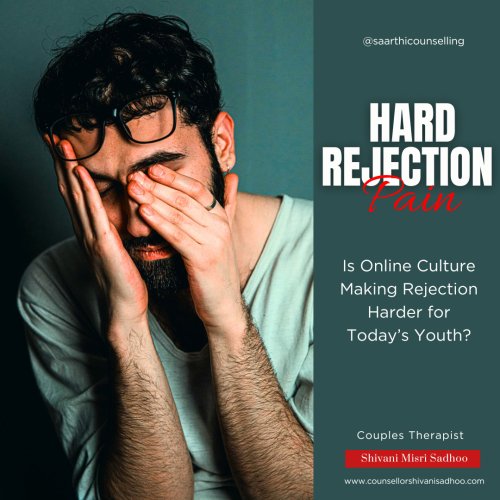
Is Online Culture Making Rejection Harder for Today’s Youth?

Rejection has always been a part of growing up, but for today’s youth, it often feels heavier, louder, and more public than ever before. In a world shaped by social media, instant feedback, and constant comparison, rejection is no longer just a private disappointment.

It can feel like a public verdict. From being left on “read” to not getting enough likes or being excluded online, digital culture has transformed how young people experience and process rejection. This raises an important question about whether the online world is making emotional resilience harder to build, says Shivani Misri Sadhoo, who is one of the top couples therapists and relationship counsellors in Delhi.
relationship in digital age insight by relationship counsellor Shivani Misri Sadhoo

Rejection in the Age of Visibility

In earlier generations, rejection usually happened in limited social circles. A declined invitation, a failed exam, or a romantic disappointment was often experienced privately or shared with a few trusted people. Today, online platforms make social interactions visible and measurable.

When a post receives little engagement or a message goes unanswered, rejection feels quantified and exposed. For many young people, these small digital signals are interpreted as judgments on their worth, making rejection feel constant rather than occasional.
relationship in digital age insight by relationship counsellor Shivani Misri Sadhoo

The Pressure of Constant Comparison

Social media encourages users to compare their lives with carefully curated versions of others’ success and happiness. When young people see peers achieving milestones, gaining attention, or appearing confident and admired, rejection can feel like personal failure rather than a normal life experience.

This comparison culture amplifies self-doubt and can make setbacks feel more significant than they truly are. Instead of seeing rejection as a temporary obstacle, many begin to internalise it as a defining trait.
relationship in digital age insight by relationship counsellor Shivani Misri Sadhoo

Fear of Public Failure

Online culture has blurred the line between private mistakes and public embarrassment. A rejection can quickly become visible through screenshots, unfollows, or subtle online signals. This creates a fear of trying at all.

Many young people hesitate to apply for opportunities, express feelings, or share creative work because the possibility of rejection feels too public and permanent. The internet rarely forgets, and this perceived permanence adds emotional weight to every risk.
relationship in digital age insight by relationship counsellor Shivani Misri Sadhoo

Reduced Opportunities to Build Resilience

Resilience is often built through repeated exposure to disappointment and recovery. However, digital interactions can limit this process. Online rejection tends to be abrupt, silent, or ambiguous, offering little explanation or closure.

Being ignored or excluded online does not provide the feedback needed to learn and grow. Over time, this can make rejection feel confusing and deeply personal, rather than a normal part of human interaction.

Emotional Validation and External Approval

Online culture places strong emphasis on validation through likes, comments, and followers. When approval becomes external and numerical, rejection feels like the absence of value. Youth who grow up equating attention with self-worth may struggle more when validation is withdrawn. This dependency can make rejection emotionally overwhelming, as it challenges both confidence and identity.

Learning to Reframe Rejection

Despite these challenges, online culture does not make rejection impossible to handle; it simply changes how it must be understood. Teaching young people to separate online feedback from self-worth is essential.

Rejection, whether online or offline, is not a reflection of personal value but a natural outcome of diverse opinions, preferences, and circumstances. Developing digital literacy, emotional awareness, and self-compassion can help youth navigate rejection more healthily.

Online culture has undeniably reshaped how today’s youth experience rejection, making it more visible, frequent, and emotionally intense. While this environment presents new challenges, it also offers an opportunity to redefine resilience for the digital age. By encouraging meaningful offline connections, fostering self-worth beyond online approval, and normalising rejection as part of growth, young people can learn not only to cope with rejection but to grow stronger through it.

Being in a Relationship counselling advice Shivani Misri Sadhoo

What is the True Meaning of Being in a Relationship?

We live in an era where boys and girls fall in love quickly—and drift apart just as easily. Whether you are in a situationship, where you are still in the friendship zone, and not yet a couple, or a texlationship, which is based primarily on texting with little to no real-life interaction, modern relationships are undeniably volatile.

With the advent of social media, true emotions are hard to decipher. We often wonder if in this age of interconnectedness, we have actually become more disconnected. Amid the noise of notifications and filtered personas, have we lost the warmth of genuine human connection? Shivani Misri Sadhoo, a relationship expert and certified relationship counsellor, tells her readers what being in a relationship truly means.

In simple words, the term ‘relationship’ refers to the connection or bond between two or more people. When a couple is in a relationship, they are emotionally attached to each other. Leading marriage counsellor in India, Shivani Misri Sadhoo, explains the real meaning of relationship in this blog.

What is the True Meaning of Being in a Relationship?

What is The Real Meaning of Being in A Relationship?

To have Faith

Yes, perhaps the ubiquitous truth—faith or trust is the basic foundation of any healthy relationship. If you are in a relationship with someone, the ability to believe in them, the way they behave and their intentions is vital. Faith means giving someone the benefit of the doubt, even when circumstances test your patience.

It’s knowing that your partner has your best interests at heart, even when times are tough. Without faith, insecurity creeps in, and love slowly erodes. It’s not only about trusting that your partner would choose fidelity over betrayal, but also trusting that they will show up for you emotionally, be honest with their feelings, and stand by your side through life’s unpredictability.

To Understand Each Other

Love is not the only glue that holds a relationship together. Mutual understanding is very important. Partners need to understand each other. Sometimes silence speaks louder than words. A couple should be able to understand each other’s feelings and emotions without always having to explain them.

To understand someone is to be aware of their feelings, to have empathy, and to genuinely care about their inner world. Studies reveal that most of the relationships crumble not because couples fall out of love, but because there is a lack of proper understanding and communication.

To Not Judge Each Other

Another very important aspect in a relationship is not to judge each other. Many a time, even if the partners know each other well, it’s easy to fall into the trap of making assumptions or passing judgments, especially during moments of stress or disagreement. When one partner feels judged, it can lead to defensiveness, withdrawal, or even resentment.

Instead, couples should sit together and sort out their misunderstandings with patience, empathy and open communication. The moment you start judging each other over trivial issues, the trust that has been built over time can begin to erode.

To Stand by Each Other

In a true relationship, partners should always stand by each other, irrespective of the situation. One cannot always predict the challenges life will throw their way, but unconditional support, empathy, and commitment help couples endure and grow stronger.

It doesn’t really matter what the issue is; the most important thing is to be with your significant other when they need you the most. It is not only about celebrating the joys – it’s also about weathering the storms together.

Meaning of Being in a Relationship - Couples goals

To be friends first

If you want a fulfilling relationship, a true relationship, then be a friend to your partner. Friendship is perhaps the most important ingredient of a successful relationship. Friends understand each other, accept each other the way they are and do not judge. It’s easy to be swept away by passion or attraction, but those flames alone can flicker and fade.

That is ephemeral. What truly lasts forever is the kind of connection rooted in friendship. When you are a friend to your partner, you forgive each other easily without holding grudges. Communication is candid. There are no ifs and buts.

To Accept Their Imperfections

A relationship becomes meaningful when you accept your partner just the way they are. Nobody is perfect. You may be good at something your partner struggles with, and vice versa. That’s the true meaning of being in a relationship, when you accept each other’s flaws and strengths equally, supporting one another through growth and vulnerability.

When you love someone, you do not try to change them or mold them into someone they are not. Instead, you embrace their imperfections and create a safe space where both of you can be your authentic selves. A meaningful relationship is built on mutual respect, trust, and understanding. It’s not about fixing each other, but about growing together. It’s about being each other’s anchor during the storms and celebrating the sunshine side by side.

Ultimately, being in a relationship means having faith, understanding each other deeply, and accepting one another without judgment. It’s about being true friends, offering unconditional support, and embracing imperfections. A real relationship is built on trust, empathy, and love that grows stronger through every challenge shared together.