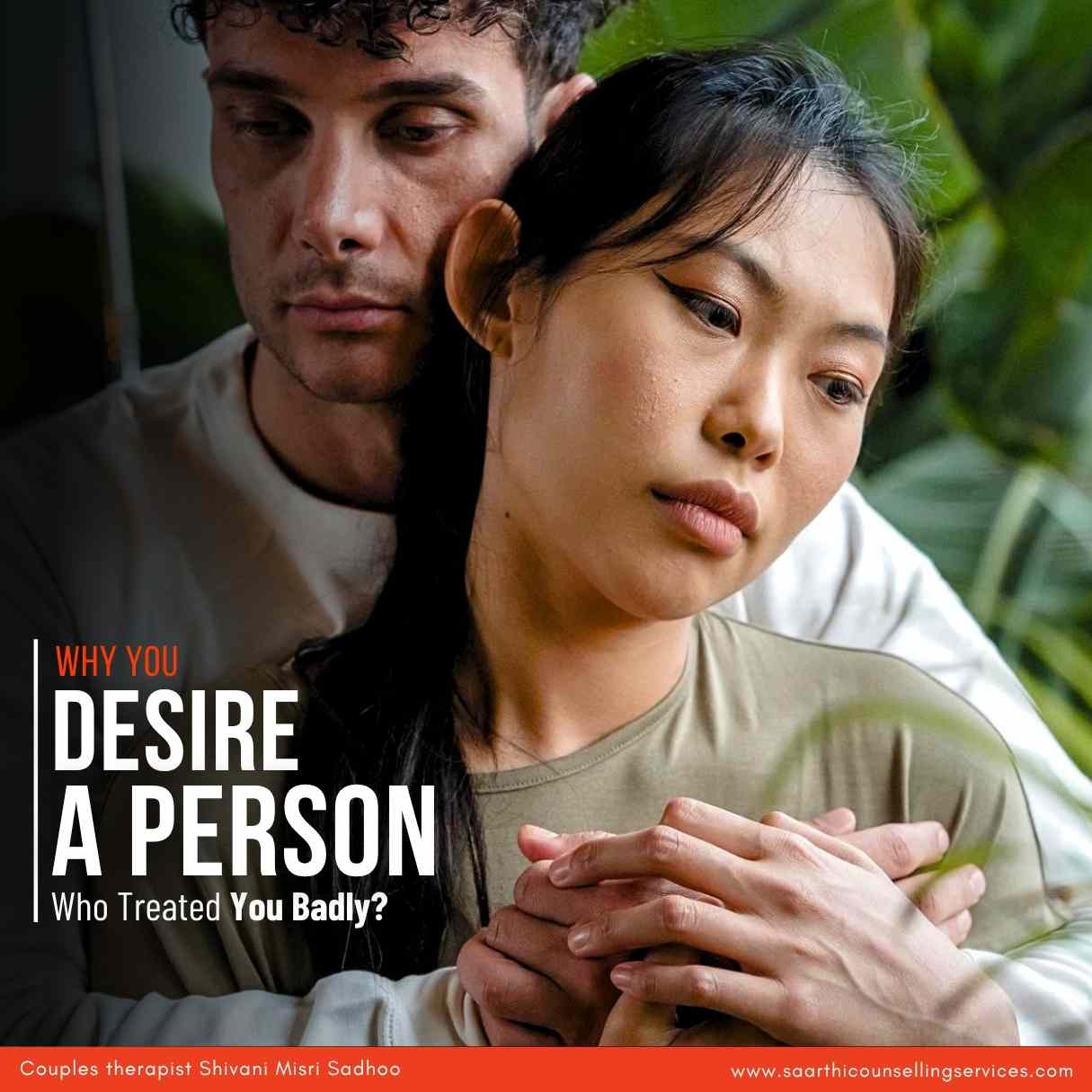
Why You Desire a Person Who Treated You Badly
Relationship Expert’s Direct Answer Summary
- Missing someone does not mean they were good for you.
- You may be craving connection, validation, or closure.
- Judge the relationship by patterns, not only memories.
It can be confusing to miss someone who hurt you. You may know that the relationship was unhealthy, remember the moments when you felt disrespected, and still find yourself thinking about that person or wanting them back. This does not necessarily mean you made the wrong decision by leaving.
Emotional attachment does not disappear simply because someone treated you badly. Feelings, memories, hopes, and unresolved emotions can remain long after a relationship has ended. Understanding why this happens can help you separate genuine compatibility from emotional attachment, shares Shivani Misri Sadhoo who is an eminent marriage counselor in Delhi.
Why Do You Still Desire Someone Who Hurt You?
One reason is that the mind does not process a relationship only through its negative experiences. You may remember the affection, attention, chemistry, laughter, or moments when the person made you feel special alongside the painful experiences.
When positive and negative experiences exist together, it can become difficult to make sense of the relationship. You may intellectually understand that the person was not good for you while emotionally continuing to crave the connection.
“You can deeply desire someone and still recognise that being with them is not good for you.” Says, couples and relationship counselor Shivani Misri Sadhoo.
Can Intermittent Attention Make Attachment Stronger?
Yes. When affection and rejection alternate unpredictably, the emotional experience can become particularly difficult to let go of.
Periods of warmth, attention, apologies, or affection may create hope that the relationship will return to its better moments. When that attention disappears again, you may find yourself wanting it even more.
This cycle can make emotional attachment feel stronger than it would in a consistently healthy relationship.

Are You Missing the Person or the Feeling They Gave You?
Sometimes, what you miss is not necessarily the individual but how you felt when things were good.
You may miss feeling wanted, attractive, understood, important, or emotionally connected. You may also miss the future you imagined with that person.
Recognising this difference can be important. Missing a feeling does not automatically mean that reconnecting with the person is the right decision.
Why Do You Remember the Good Moments More?
After a relationship ends, the mind can selectively focus on emotionally powerful memories. A few happy moments may suddenly seem more significant than the repeated experiences that caused pain.
Nostalgia can also soften difficult memories. You might remember a romantic conversation, a special trip, or a loving gesture while temporarily overlooking the disrespect, inconsistency, or emotional distress that accompanied the relationship.
This can create an idealised version of the person in your mind.
Does Unfinished Emotional Business Keep You Attached?
Unresolved questions can keep emotional attachment alive. You may wonder why they changed, whether they ever truly loved you, whether you could have done something differently, or whether the relationship could have worked under different circumstances.
The desire for an explanation can sometimes keep you emotionally connected to someone even when the relationship itself was damaging.
Closure, however, does not always come from the other person. Sometimes it comes from accepting what the relationship showed you and deciding what you will no longer accept.

Can Low Self-Worth Influence This Desire?
When someone has repeatedly experienced criticism, rejection, or inconsistent affection, they may begin questioning their own worth.
They may unconsciously believe that winning the person’s love or approval would prove that they were good enough. This can turn the desire for reconciliation into a desire for validation.
A healthy relationship should not require you to earn basic respect or repeatedly prove your worth.
Why Does Letting Go Feel Like Losing?
Ending an unhealthy relationship can involve grieving more than the person. You may also be grieving the future you imagined, the relationship you hoped it would become, and the version of the person you believed they could be.
That grief can make separation feel like a mistake, even when leaving was necessary.
Allowing yourself to grieve does not mean you should return. It means acknowledging that something emotionally significant has ended.
How Can You Understand What You Really Want?
Instead of asking only, “Do I still love this person?”, consider asking yourself what you actually want from the relationship.
Would you want the relationship exactly as it was, including the behaviour that hurt you? Or do you want the version of the relationship you hoped it could become?
Looking honestly at patterns rather than isolated memories can help you make a clearer decision.

When Should You Avoid Reconnecting?
Strong feelings are not necessarily evidence that a relationship is healthy. If the person repeatedly disrespects your boundaries, manipulates you, emotionally harms you, or shows no meaningful willingness to change, desire alone should not determine whether you reconnect.
Healthy relationships require respect, emotional safety, accountability, consistency, and mutual effort.
If a relationship involves abuse or you feel unsafe, prioritise your safety and seek support from someone you trust or a qualified professional.
Desiring someone who treated you badly does not make you weak or irrational. Emotional attachment can survive disappointment, rejection, and even painful relationship experiences.
The important question is not simply whether you still want the person. It is whether the relationship, as it actually existed, was capable of giving you the respect, safety, consistency, and care you deserve.
Sometimes moving forward begins when you stop confusing intense feelings with a healthy connection.

Shivani Misri Sadhoo specializes in infidelity recovery, pre-marital counseling, marriage counseling, couples therapy, CBT (Cognitive Behavioral Therapy), DBT (Dialectical Behavior Therapy), EFT (Emotionally Focused Therapy), relationship issues, separation and divorce, child and adolescent concerns, depression, anxiety, grief and loss. She is also one of the leading online couples therapists in India and for couples who are living in the US, the UK, Australia, Europe and Dubai.
A Certified Neuro-Linguistic Practitioner and a Level 3 Trained Gottman Method Couples Therapist , Marriage Counselor Shivani Sadhoo integrates modern therapeutic techniques with a warm, client-centered approach to create lasting transformation in her clients’ lives.
Counsellor Shivani is currently working with India 's top hospital groups like Fortis Hospital (former), IBS (Indian Brain & Spine) Hospital

Call Counselor: +91-8860875040
Email:saarthiforlife@gmail.com
Gottman Certification: Level 3 Trained Gottman Method Couples Therapist
- Why You Desire a Person Who Treated You Badly - October 8, 2026
- Are You Delulu in Love? The Gen Z Dating Trend Taking Romance to Another Level - September 30, 2026
- The “Relationship Potential” Trap: Are You Loving the Person or Their Future Version? - September 23, 2026